London Blue Topaz—The Origin of its Twilight Hue
“Is London Blue Topaz natural?”
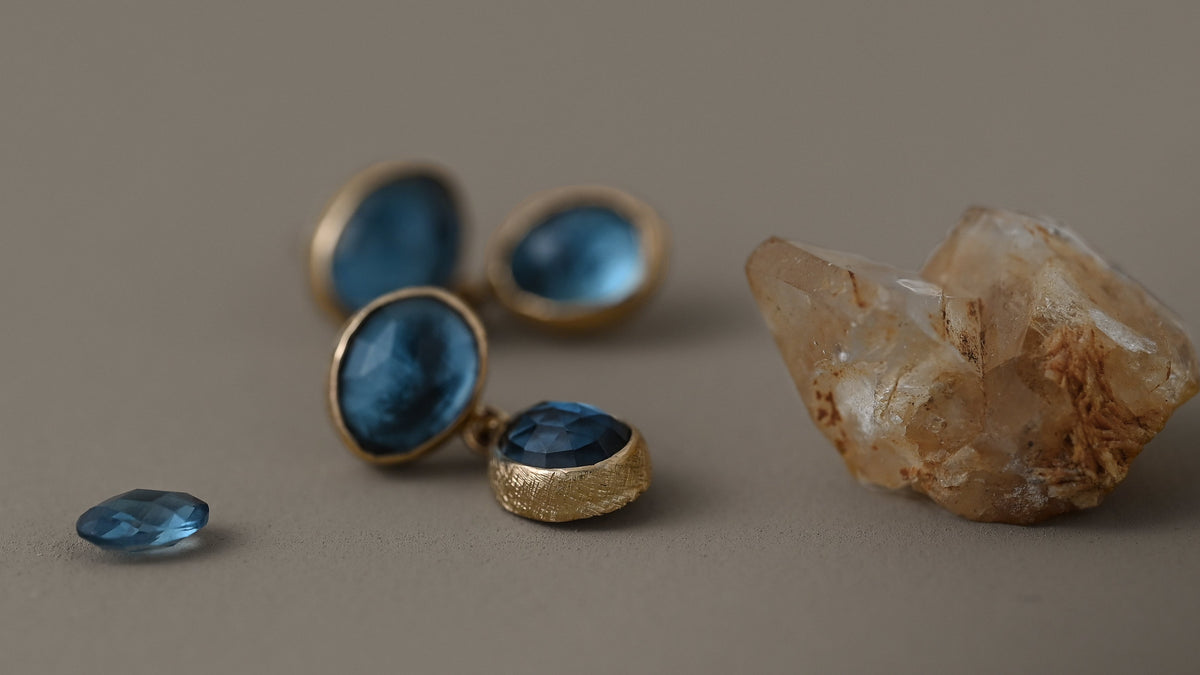
The deep, inky blue of London Blue Topaz is one of the most distinctive colours in the gemstone world. Richer and moodier than Swiss Blue, with subtle grey and sometimes green undertones, its colour resembles the depths of the ocean rather than the brightness of a summer sky. But is this extraordinary colour found in nature, or is it created by science?
The answer is a fascinating meeting of the two. Nature discovered the process millions of years ago, and modern science has learned to reproduce it.
“Nature made blue topaz first”
Topaz occurs naturally in a remarkable range of colours, from colourless to golden yellow, pink, orange and occasionally blue. However, naturally occurring blue topaz is exceptionally uncommon, and its colour is generally much paler than the saturated blues familiar in jewellery today.
Deep within the Earth, gemstones are exposed to natural radiation from surrounding rocks and minerals. Over immense periods of geological time, this radiation can alter the internal structure of a crystal, creating what gemmologists call colour centres. These tiny changes affect how the gemstone absorbs light, allowing particular colours to become visible. In topaz, natural irradiation can produce blue.
Some of the world's most remarkable naturally blue topazes have been discovered in Brazil, including the extraordinary 9,381-carat Ostro Topaz, now in London's Natural History Museum. The discovery that radiation could influence the colour of topaz eventually opened the door to one of the gemstone industry's most successful colour treatments.
“Science perfected nature's process”
By the 1970s, scientists had developed commercial methods of transforming abundant colourless topaz into beautiful blue gemstones through controlled irradiation and subsequent heat treatment. The principle is remarkably similar to what occurs naturally beneath the Earth's surface, although the process takes place over a much shorter period.
Radiation changes the way the topaz crystal absorbs light, producing blue colour centres. Carefully controlled heating can then modify or stabilise the resulting colour. Different irradiation methods produce different shades of blue. Electron irradiation is commonly associated with the brighter Swiss Blue colours, while neutron irradiation is particularly important in producing the deeper, more saturated London Blue.
The result is a genuine natural gemstone whose colour has been enhanced by science. No blue dye or artificial pigment is introduced into the crystal. The colour develops through changes within the gemstone itself.
“Why is it called London Blue?”
For a gemstone with such a recognisable name, its origins are surprisingly uncertain. London Blue is a commercial trade name used to describe the darker, more subdued shades of treated blue topaz. Unlike the names of many gemstones, it does not identify a particular geographical source.
Various explanations have been suggested, including an association with London's famously grey skies and the sophistication of its darker blue colour. However, there appears to be no widely documented account establishing exactly who first used the name or why.
London Blue is generally deeper and less vivid than Swiss Blue, with a distinctive combination of blue, grey and occasionally greenish undertones. These subtle variations give the gemstone its characteristic inky appearance, particularly appealing in fine jewellery when contrasted with the warmth of yellow gold.
“Does irradiation make topaz radioactive?”
The word irradiation can understandably raise questions, particularly when the treatment involves nuclear reactors. Neutron irradiation can temporarily make topaz radioactive by activating certain trace elements within the gemstone. This is why irradiated stones must undergo appropriate testing and, where necessary, a period of storage until any induced radioactivity has fallen below regulated safety limits.
Commercially released blue topaz must meet the applicable radiation safety requirements before entering the jewellery market. Once properly cleared, treated blue topaz is safe to wear. The treatment is also remarkably stable, with London Blue generally retaining its deep colour under normal jewellery-wearing conditions.
“A colour born from nature, refined by science”
There is an interesting question surrounding gemstone treatments. If nature can produce a colour through radiation, does reproducing that same process scientifically make the resulting gemstone any less natural?
The topaz crystal itself remains a natural mineral. Its chemical composition and fundamental identity are unchanged. What science has altered is the arrangement of defects within the crystal that determine how light is absorbed. Gemstone treatments have existed for centuries, from the heating of corundum to improve sapphire and ruby colours to the more recent development of irradiation techniques. Modern gemmology recognises that treatments are an established part of the gemstone industry, provided they are accurately disclosed.
There is also a practical consideration. Colourless topaz is relatively abundant, often occurring in large, exceptionally clear crystals. Rather than overlooking this material because it lacks a desirable natural colour, treatment allows it to become a gemstone of extraordinary beauty.
London Blue Topaz offers generous size, excellent clarity and a depth of colour that would be exceptionally rare and expensive to find naturally. Perhaps its greatest appeal lies in that relationship between geology and human ingenuity.
Nature created the possibility of blue topaz millions of years ago. Science has simply learned how to reveal its midnight hue.